Author: Andy

  • Audio and Video Production Tips and Tricks

    Audio and Video Production Tips and Tricks

    Link to the slideshow presentation here

    Open Broadcast Studio: https://obsproject.com/

    Shotcut (Video editing): https://shotcut.org/

    Audacity (Audio editing): https://www.audacityteam.org/

    Voice Meeter (Software mixer): https://www.vb-audio.com/Voicemeeter/

    Microphone: AT2005USB B007JX8O0Y

    Ring light:  10” Selfie Ring Light B07W66QFPR

    WebCam: Logitech C920 B006JH8T3S

    Lapel Microphone:  PowerDeWise B01AG56HYQ

    Green Screen: B00E89Q5OY

    Teleprompter: PromptSmart Pro – https://bit.ly/2XzEFTz


  • Building a products attributes override

    This week, I was working on a clients site that presented a problem with the pull-down menu of the product page. The old version of the template had the attributes image show in the pulldown menu with the image showing as you hover over the colors. The default configuration of Zen Cart shows all of the attributes below the attribute text.

    before_1

    But what we want looks like this:

    Another incredibly important element to this project is that we want to make sure that as we move forward with upgrades to Zen Cart, that this change in behavior is persistent. If we were to go change the core functionality of Zen Cart, then an upgrade would trash this change and we’d have to go track it down. We are therefore only going to change files in our template. And we’re going to build an override into Zen Cart so that this sticks.

    The first thing we want to do is customize the template to not display the image below the selection list. We desired functionality is to have it be a ‘tooltip’ type display during the rollover.

    desired_output

    Inside your template, which is located in:
    /includes/templates/YOURTEMPLATE/templates/tpl_modules_attributes.php
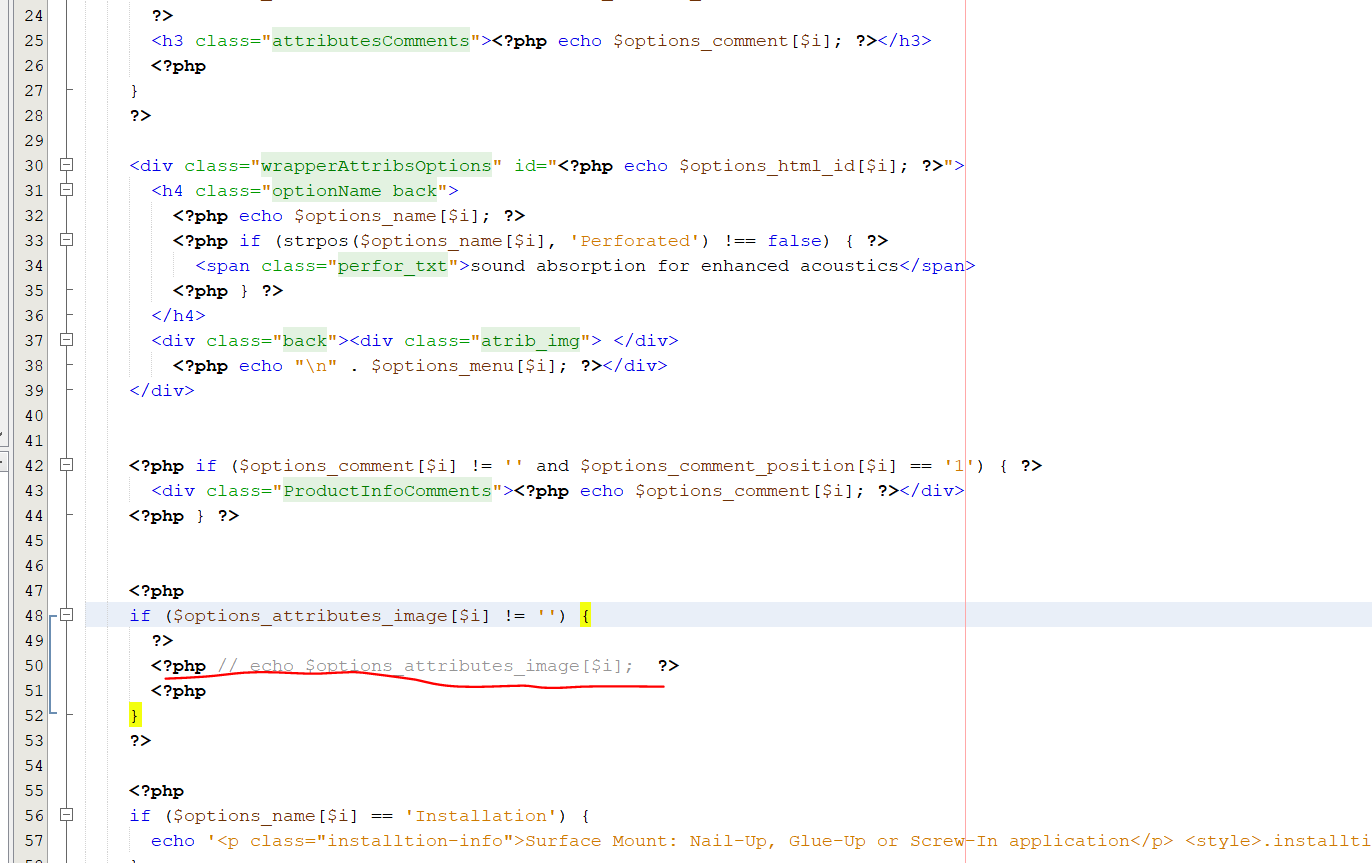
    In the responsive_classic template, around line 50 you will the below image and take note that it has already been commented out.
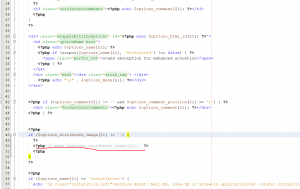
    options_attributes_image

    This takes us to this.

    after_1

    I know what you’re thinking. Big whoop. You removed an image. Right. I know. Let’s move on to where things get more exciting.

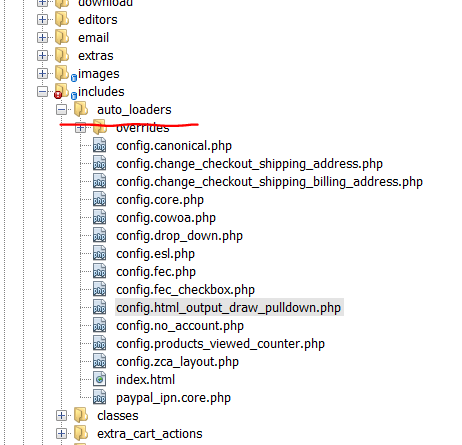
    The first part of the magic comes from telling Zen Cart to include a file when the engine starts up. This comes from a pretty simple file that is located in /includes/auto_loaders
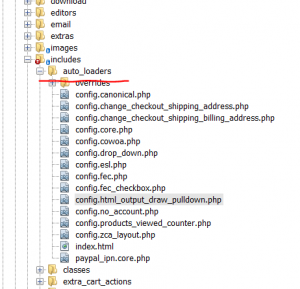
    auto_loaders

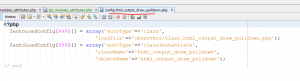
    We create a new file in this folder. You can name it anything you want, but I chose to use the same naming convention that is already in there. This name accurately describes what we’re trying to do: which is to change the html output of a pulldown menu.
    html_output_draw_pulldown

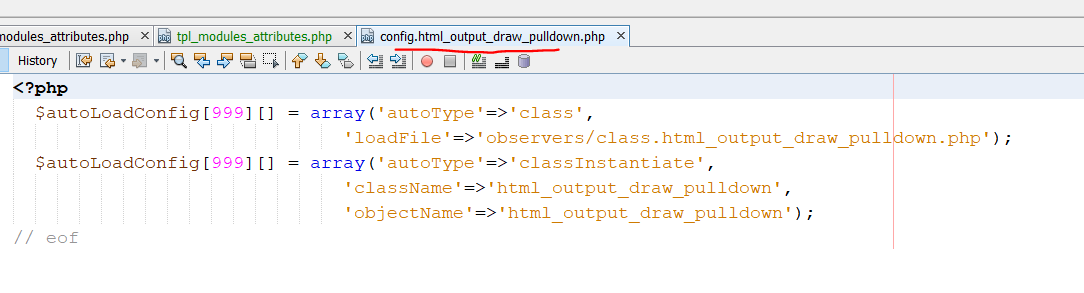
    The contents of this files includes two operations. First is tells Zen Cart to include a file and it gives it the path. The second is that it instantiates a new object for us to call later.

    <?php 
    $autoLoadConfig[999][] = array('autoType'=>'class',
    'loadFile'=>'observers/class.html_output_draw_pulldown.php');
    $autoLoadConfig[999][] = array('autoType'=>'classInstantiate',
    'className'=>'html_output_draw_pulldown',
    'objectName'=>'html_output_draw_pulldown');
    // eof

    Since the default functionality of the html pulldown doesn’t operate the way that we want, let’s quickly talk about how we’re going to override the default functionality of Zen Cart. It is very cool that the Zen Cart developers added the observer methods into the mix. They even explicitly wrote a comment that offers the ability to totally override the output. And when that is done, the default function bails out and returns the results. Notice the $GLOBALS[‘zco_notifier’]->notify(NOTIFY_ZEN_DRAW_PULL_DOWN_MENU_OVERRIDE’, etc etc etc). When the html_draw_pulldown function is called, if there is a method attached to the notifier, it detours off.
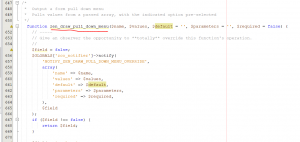
    default_function_html_draw_pulldown

    Let us create a new file located in: includes/classes/observers/class.html_output_draw_pulldown.php

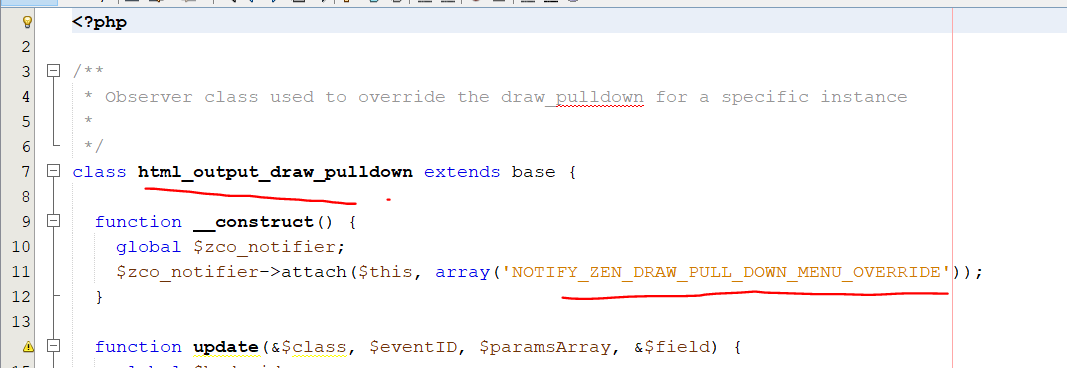
    Here is the top of the new file we’ve created. We extend the base class of Zen Cart. Then we have the __construct method. Take a look at line 11. The attach method has a parameter of NOTIFY_ZEN_DRAW_PULL_DOWN_MENU_OVERRIDE in it. This is how Zen Cart gets things bolted on to it.
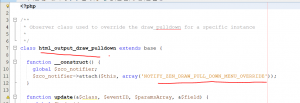
    notifier_1

    class html_output_draw_pulldown extends base {
    
    function __construct() {
    global $zco_notifier;
    $zco_notifier->attach($this, array('NOTIFY_ZEN_DRAW_PULL_DOWN_MENU_OVERRIDE'));
    }
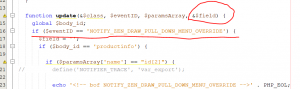
    

    notifier_2

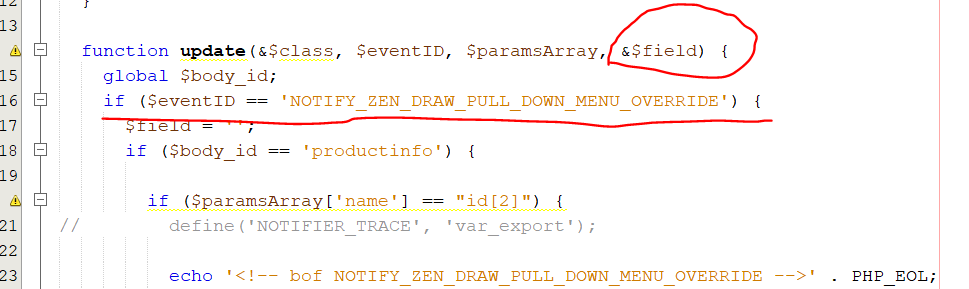
    Take a look at line 14 with the function update. The 2nd argument is $eventID. This corresponds to the “if” statement on line 16. This starts us down the decision tree path to update the function. However, we don’t want to indiscriminately update every drawdown menu where ever it may get used. We want to target it to this page and type. Take a quick detour up one line to line 16 that has $body_id. This is a Zen Cart variable that has which page we are on. It removes misc punctuation, etc and formats it in a way that we can easily trap it. In this case ‘productinfo’.

    To recap where we are so far. We have told Zen Cart to include a file, and instantiate a class called html_output_draw_pulldown. This class is attached to the notifier object to get called at the appropriate time by the $eventID variable.

    Way back at the top of this article, there is a screenshot of the original function for the html pulldown. It has lists all of the parameters that would have been called for the standard function to be used. These parameters all get stuffed into the $paramsArray variable to be picked up by the update method in our new class. We have the form element name, the values, the default value, extra parameters and if the field is a required field. All of this gets passed over to our new code.

    One other if statement that seemed to be appropriate to include is on line 20. This is where your field name may be different. On my clients site, it is

    <select name="id[2]" id="attrib-2">

    and on the demo data for Zen Cart it is

    <select name="id[3]" id="attrib-3">

    I know, pretty insignificant difference. But important for our “if” statement. And I guess this is all going to be a bit anticlimactic because, this just creates a string that builds up our html output to be returned. This is where you can customize the output to be whatever you want.

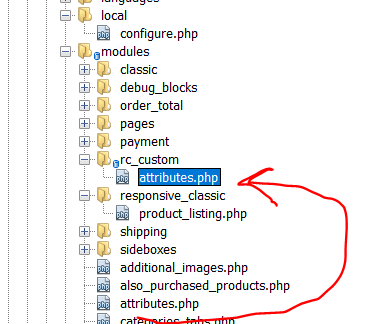
    Now that we’ve gotten here with modifying the function, we run into another challenge. The default version of attributes.php doesn’t send over the image the way we need it. We will modify the attributes.php stock version for our own purposes here as well. The steps taken to accomplish this is to locate:

    make a folder includes/modules/YOURTEMPLATE. copy includes/modules/attributes.php -> includes/modules/YOURTEMPLATE/
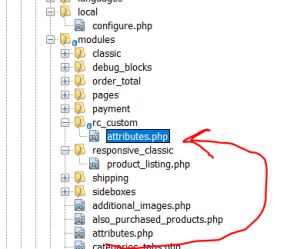
    copy_attributes

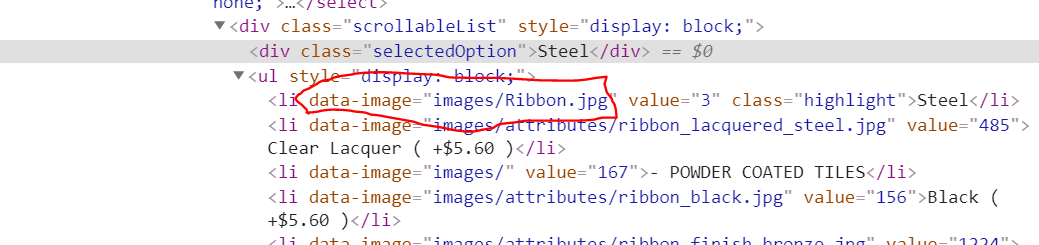
    Open up the new version of attributes, and somewhere around line 115, we’re going to tweak the output just a bit.attributes_after

     $products_options_array[] = array('id' => $products_options->fields['products_options_values_id'],
    'text' => $products_options->fields['products_options_values_name'],
    'data-image' => 'images/' . $products_options->fields['attributes_image']
    );

    We’ve added the attributes_image to the bottom of the array. When we reload the Zen Cart site, our html output has the information in it now.
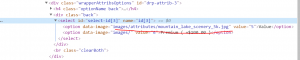
    html_output_with_image_included

    Toss in the css and javascript files. Then when the page loads, you get something that should look like this:


    Download project files here

  • Yoga Training Will Improve Your Life

    Yoga Training Will Improve Your Life

    Our psoas major muscle, sometimes lovingly called, the “muscle of the soul”, is a core-stabilizing muscle and runs from the thigh bone through the length of the belly, connected at the lowest thoracic vertebra, around where your rib cage ends, all the way down your lower back, extending through the pelvis to attach on the inside of the upper femur. It crosses three major joints, the hip socket, the joint between the lumbar spine and the sacrum, and the sacroiliac joint- that’s a lot of coverage!

    And it is responsible for so much as well. It affects our mobility, structural balance, joint function, flexibility, and not only helps you stand up straight and lift your legs to walk, research shows that this incredible part of our body, is also vital to our psychological wellbeing.

    Liz Koch, the author of The Psoas Book, writes that our psoas “literally embodies our deepest urge for survival, and more profoundly, our elemental desire to flourish.” By keeping our psoas healthy, it is entirely possible to improve mental health, or if to speak in yogi terms, having the ability to create healing energy.

    Part of the stress response that is in our nervous system is the contraction of the major flexors of the torso. When we go through stress, trauma, or something unpleasant, even if its just small little incident or an argument with a loved one, it is all tied together. Our body responds by tightening the gut, hunching the shoulders, holding it all in tightly as a modern response to protect ourselves. All of the things we have been holding in turns into chronic tension and contraction, and we start thinking of it as normal, we actually get used to the pain.

    Because of negative social standards, we have ignored our natural way of releasing tension in our bodies and our psoas, just like animals instinctual shake to discharge tension, we used to do the same- ever heard someone say, “shake it off”? Since early age we have learned that shakes, tremors, or to show vulnerability is a sign of weakness, and that we must hold everything in so tightly instead of just allowing us to let go. If you think back of a time you were crying and very upset about something, didn’t your body automatically start to shake and tremor?

    Our bodies are filled with incredible capabilities, many we take for granted or don’t even pay much attention to.

    Source: Mandy Martini’s blog

  • Overcome Your Body Weakness with Your Mind

    Overcome Your Body Weakness with Your Mind

    Our psoas major muscle, sometimes lovingly called, the “muscle of the soul”, is a core-stabilizing muscle and runs from the thigh bone through the length of the belly, connected at the lowest thoracic vertebra, around where your rib cage ends, all the way down your lower back, extending through the pelvis to attach on the inside of the upper femur. It crosses three major joints, the hip socket, the joint between the lumbar spine and the sacrum, and the sacroiliac joint- that’s a lot of coverage!

    And it is responsible for so much as well. It affects our mobility, structural balance, joint function, flexibility, and not only helps you stand up straight and lift your legs to walk, research shows that this incredible part of our body, is also vital to our psychological wellbeing.

    Liz Koch, the author of The Psoas Book, writes that our psoas “literally embodies our deepest urge for survival, and more profoundly, our elemental desire to flourish.” By keeping our psoas healthy, it is entirely possible to improve mental health, or if to speak in yogi terms, having the ability to create healing energy.

    Part of the stress response that is in our nervous system is the contraction of the major flexors of the torso. When we go through stress, trauma, or something unpleasant, even if its just small little incident or an argument with a loved one, it is all tied together. Our body responds by tightening the gut, hunching the shoulders, holding it all in tightly as a modern response to protect ourselves. All of the things we have been holding in turns into chronic tension and contraction, and we start thinking of it as normal, we actually get used to the pain.

    Because of negative social standards, we have ignored our natural way of releasing tension in our bodies and our psoas, just like animals instinctual shake to discharge tension, we used to do the same- ever heard someone say, “shake it off”? Since early age we have learned that shakes, tremors, or to show vulnerability is a sign of weakness, and that we must hold everything in so tightly instead of just allowing us to let go. If you think back of a time you were crying and very upset about something, didn’t your body automatically start to shake and tremor?

    Our bodies are filled with incredible capabilities, many we take for granted or don’t even pay much attention to.

    Source: Mandy Martini’s blog

  • Reach the Inner Peace of Your Soul & Body

    Reach the Inner Peace of Your Soul & Body

    Our psoas major muscle, sometimes lovingly called, the “muscle of the soul”, is a core-stabilizing muscle and runs from the thigh bone through the length of the belly, connected at the lowest thoracic vertebra, around where your rib cage ends, all the way down your lower back, extending through the pelvis to attach on the inside of the upper femur. It crosses three major joints, the hip socket, the joint between the lumbar spine and the sacrum, and the sacroiliac joint- that’s a lot of coverage!

    And it is responsible for so much as well. It affects our mobility, structural balance, joint function, flexibility, and not only helps you stand up straight and lift your legs to walk, research shows that this incredible part of our body, is also vital to our psychological wellbeing.

    Liz Koch, the author of The Psoas Book, writes that our psoas “literally embodies our deepest urge for survival, and more profoundly, our elemental desire to flourish.” By keeping our psoas healthy, it is entirely possible to improve mental health, or if to speak in yogi terms, having the ability to create healing energy.

    Part of the stress response that is in our nervous system is the contraction of the major flexors of the torso. When we go through stress, trauma, or something unpleasant, even if its just small little incident or an argument with a loved one, it is all tied together. Our body responds by tightening the gut, hunching the shoulders, holding it all in tightly as a modern response to protect ourselves. All of the things we have been holding in turns into chronic tension and contraction, and we start thinking of it as normal, we actually get used to the pain.

    Because of negative social standards, we have ignored our natural way of releasing tension in our bodies and our psoas, just like animals instinctual shake to discharge tension, we used to do the same- ever heard someone say, “shake it off”? Since early age we have learned that shakes, tremors, or to show vulnerability is a sign of weakness, and that we must hold everything in so tightly instead of just allowing us to let go. If you think back of a time you were crying and very upset about something, didn’t your body automatically start to shake and tremor?

    Our bodies are filled with incredible capabilities, many we take for granted or don’t even pay much attention to.

    Source: Mandy Martini’s blog

  • The Harder You Train the Better the Results

    The Harder You Train the Better the Results

    Our psoas major muscle, sometimes lovingly called, the “muscle of the soul”, is a core-stabilizing muscle and runs from the thigh bone through the length of the belly, connected at the lowest thoracic vertebra, around where your rib cage ends, all the way down your lower back, extending through the pelvis to attach on the inside of the upper femur. It crosses three major joints, the hip socket, the joint between the lumbar spine and the sacrum, and the sacroiliac joint- that’s a lot of coverage!

    And it is responsible for so much as well. It affects our mobility, structural balance, joint function, flexibility, and not only helps you stand up straight and lift your legs to walk, research shows that this incredible part of our body, is also vital to our psychological wellbeing.

    Liz Koch, the author of The Psoas Book, writes that our psoas “literally embodies our deepest urge for survival, and more profoundly, our elemental desire to flourish.” By keeping our psoas healthy, it is entirely possible to improve mental health, or if to speak in yogi terms, having the ability to create healing energy.

    Part of the stress response that is in our nervous system is the contraction of the major flexors of the torso. When we go through stress, trauma, or something unpleasant, even if its just small little incident or an argument with a loved one, it is all tied together. Our body responds by tightening the gut, hunching the shoulders, holding it all in tightly as a modern response to protect ourselves. All of the things we have been holding in turns into chronic tension and contraction, and we start thinking of it as normal, we actually get used to the pain.

    Because of negative social standards, we have ignored our natural way of releasing tension in our bodies and our psoas, just like animals instinctual shake to discharge tension, we used to do the same- ever heard someone say, “shake it off”? Since early age we have learned that shakes, tremors, or to show vulnerability is a sign of weakness, and that we must hold everything in so tightly instead of just allowing us to let go. If you think back of a time you were crying and very upset about something, didn’t your body automatically start to shake and tremor?

    Our bodies are filled with incredible capabilities, many we take for granted or don’t even pay much attention to.

    Source: Mandy Martini’s blog

  • Work Hard, Play Hard, Gain Faster.

    Work Hard, Play Hard, Gain Faster.

    Our psoas major muscle, sometimes lovingly called, the “muscle of the soul”, is a core-stabilizing muscle and runs from the thigh bone through the length of the belly, connected at the lowest thoracic vertebra, around where your rib cage ends, all the way down your lower back, extending through the pelvis to attach on the inside of the upper femur. It crosses three major joints, the hip socket, the joint between the lumbar spine and the sacrum, and the sacroiliac joint- that’s a lot of coverage!

    And it is responsible for so much as well. It affects our mobility, structural balance, joint function, flexibility, and not only helps you stand up straight and lift your legs to walk, research shows that this incredible part of our body, is also vital to our psychological wellbeing.

    Liz Koch, the author of The Psoas Book, writes that our psoas “literally embodies our deepest urge for survival, and more profoundly, our elemental desire to flourish.” By keeping our psoas healthy, it is entirely possible to improve mental health, or if to speak in yogi terms, having the ability to create healing energy.

    Part of the stress response that is in our nervous system is the contraction of the major flexors of the torso. When we go through stress, trauma, or something unpleasant, even if its just small little incident or an argument with a loved one, it is all tied together. Our body responds by tightening the gut, hunching the shoulders, holding it all in tightly as a modern response to protect ourselves. All of the things we have been holding in turns into chronic tension and contraction, and we start thinking of it as normal, we actually get used to the pain.

    Because of negative social standards, we have ignored our natural way of releasing tension in our bodies and our psoas, just like animals instinctual shake to discharge tension, we used to do the same- ever heard someone say, “shake it off”? Since early age we have learned that shakes, tremors, or to show vulnerability is a sign of weakness, and that we must hold everything in so tightly instead of just allowing us to let go. If you think back of a time you were crying and very upset about something, didn’t your body automatically start to shake and tremor?

    Our bodies are filled with incredible capabilities, many we take for granted or don’t even pay much attention to.

    Source: Mandy Martini’s blog

  • Test & Improve the Limits of Your Body

    Test & Improve the Limits of Your Body

    Our psoas major muscle, sometimes lovingly called, the “muscle of the soul”, is a core-stabilizing muscle and runs from the thigh bone through the length of the belly, connected at the lowest thoracic vertebra, around where your rib cage ends, all the way down your lower back, extending through the pelvis to attach on the inside of the upper femur. It crosses three major joints, the hip socket, the joint between the lumbar spine and the sacrum, and the sacroiliac joint- that’s a lot of coverage!

    And it is responsible for so much as well. It affects our mobility, structural balance, joint function, flexibility, and not only helps you stand up straight and lift your legs to walk, research shows that this incredible part of our body, is also vital to our psychological wellbeing.

    Liz Koch, the author of The Psoas Book, writes that our psoas “literally embodies our deepest urge for survival, and more profoundly, our elemental desire to flourish.” By keeping our psoas healthy, it is entirely possible to improve mental health, or if to speak in yogi terms, having the ability to create healing energy.

    Part of the stress response that is in our nervous system is the contraction of the major flexors of the torso. When we go through stress, trauma, or something unpleasant, even if its just small little incident or an argument with a loved one, it is all tied together. Our body responds by tightening the gut, hunching the shoulders, holding it all in tightly as a modern response to protect ourselves. All of the things we have been holding in turns into chronic tension and contraction, and we start thinking of it as normal, we actually get used to the pain.

    Because of negative social standards, we have ignored our natural way of releasing tension in our bodies and our psoas, just like animals instinctual shake to discharge tension, we used to do the same- ever heard someone say, “shake it off”? Since early age we have learned that shakes, tremors, or to show vulnerability is a sign of weakness, and that we must hold everything in so tightly instead of just allowing us to let go. If you think back of a time you were crying and very upset about something, didn’t your body automatically start to shake and tremor?

    Our bodies are filled with incredible capabilities, many we take for granted or don’t even pay much attention to.

    Source: Mandy Martini’s blog

  • Become the Master of your Body

    Become the Master of your Body

    Our psoas major muscle, sometimes lovingly called, the “muscle of the soul”, is a core-stabilizing muscle and runs from the thigh bone through the length of the belly, connected at the lowest thoracic vertebra, around where your rib cage ends, all the way down your lower back, extending through the pelvis to attach on the inside of the upper femur. It crosses three major joints, the hip socket, the joint between the lumbar spine and the sacrum, and the sacroiliac joint- that’s a lot of coverage!

    And it is responsible for so much as well. It affects our mobility, structural balance, joint function, flexibility, and not only helps you stand up straight and lift your legs to walk, research shows that this incredible part of our body, is also vital to our psychological wellbeing.

    Liz Koch, the author of The Psoas Book, writes that our psoas “literally embodies our deepest urge for survival, and more profoundly, our elemental desire to flourish.” By keeping our psoas healthy, it is entirely possible to improve mental health, or if to speak in yogi terms, having the ability to create healing energy.

    Part of the stress response that is in our nervous system is the contraction of the major flexors of the torso. When we go through stress, trauma, or something unpleasant, even if its just small little incident or an argument with a loved one, it is all tied together. Our body responds by tightening the gut, hunching the shoulders, holding it all in tightly as a modern response to protect ourselves. All of the things we have been holding in turns into chronic tension and contraction, and we start thinking of it as normal, we actually get used to the pain.

    Because of negative social standards, we have ignored our natural way of releasing tension in our bodies and our psoas, just like animals instinctual shake to discharge tension, we used to do the same- ever heard someone say, “shake it off”? Since early age we have learned that shakes, tremors, or to show vulnerability is a sign of weakness, and that we must hold everything in so tightly instead of just allowing us to let go. If you think back of a time you were crying and very upset about something, didn’t your body automatically start to shake and tremor?

    Our bodies are filled with incredible capabilities, many we take for granted or don’t even pay much attention to.

    Source: Mandy Martini’s blog

  • Mandy Martini Is The Best Yoga Teacher

    Mandy Martini Is The Best Yoga Teacher

    Our psoas major muscle, sometimes lovingly called, the “muscle of the soul”, is a core-stabilizing muscle and runs from the thigh bone through the length of the belly, connected at the lowest thoracic vertebra, around where your rib cage ends, all the way down your lower back, extending through the pelvis to attach on the inside of the upper femur. It crosses three major joints, the hip socket, the joint between the lumbar spine and the sacrum, and the sacroiliac joint- that’s a lot of coverage!

    And it is responsible for so much as well. It affects our mobility, structural balance, joint function, flexibility, and not only helps you stand up straight and lift your legs to walk, research shows that this incredible part of our body, is also vital to our psychological wellbeing.

    Liz Koch, the author of The Psoas Book, writes that our psoas “literally embodies our deepest urge for survival, and more profoundly, our elemental desire to flourish.” By keeping our psoas healthy, it is entirely possible to improve mental health, or if to speak in yogi terms, having the ability to create healing energy.

    Part of the stress response that is in our nervous system is the contraction of the major flexors of the torso. When we go through stress, trauma, or something unpleasant, even if its just small little incident or an argument with a loved one, it is all tied together. Our body responds by tightening the gut, hunching the shoulders, holding it all in tightly as a modern response to protect ourselves. All of the things we have been holding in turns into chronic tension and contraction, and we start thinking of it as normal, we actually get used to the pain.

    Because of negative social standards, we have ignored our natural way of releasing tension in our bodies and our psoas, just like animals instinctual shake to discharge tension, we used to do the same- ever heard someone say, “shake it off”? Since early age we have learned that shakes, tremors, or to show vulnerability is a sign of weakness, and that we must hold everything in so tightly instead of just allowing us to let go. If you think back of a time you were crying and very upset about something, didn’t your body automatically start to shake and tremor?

    Our bodies are filled with incredible capabilities, many we take for granted or don’t even pay much attention to.

    Source: Mandy Martini’s blog

478-287-9370